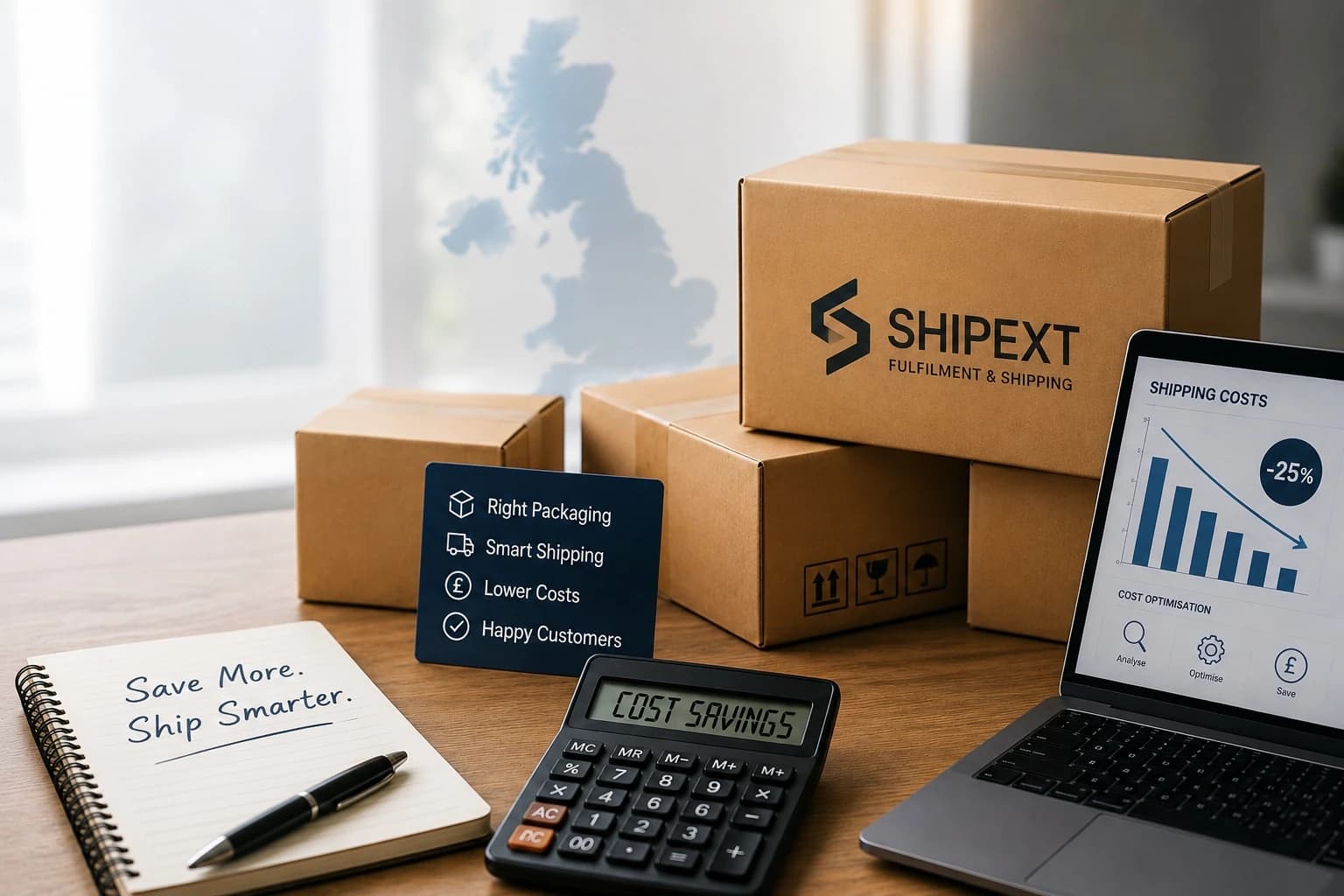
Shipping is one of the most important costs in an e-commerce operation.
Customers expect reliable and increasingly fast delivery, but businesses still need to protect their margins.
Reducing shipping costs does not necessarily mean choosing the cheapest carrier for every parcel. The entire fulfilment process can influence what you ultimately pay.
1. Use the Right Packaging Size
Oversized packaging can increase shipping costs unnecessarily.
A small product placed inside a much larger carton may result in:
- Higher dimensional weight
- More packaging material
- More warehouse space
- Higher transportation costs
Right-sizing packaging helps reduce wasted space while still protecting the product.
2. Know Your Parcel Dimensions and Weight
Accurate shipping data is essential.
For each shipment, you should understand:
- Length
- Width
- Height
- Actual weight
Carriers may calculate charges using actual or volumetric weight depending on the service.
Incorrect measurements can lead to unexpected adjustments or surcharges.
3. Use More Than One Carrier
One carrier is unlikely to be the best option for every shipment.
Different carriers may perform better depending on:
- Parcel size
- Weight
- Destination
- Delivery speed
- Domestic vs international shipment
- Service level
A multi-carrier strategy provides more flexibility.
4. Match the Service to the Order
Not every customer order requires an express service.
Offering several delivery options can help balance customer expectations and shipping costs.
For example:
- Economy
- Standard
- Tracked
- Express
- International
The right service depends on the value and urgency of the shipment.
5. Reduce Unnecessary Handling
Shipping cost is not limited to the carrier charge.
Every additional warehouse process can add operational cost.
Efficient workflows for picking, packing, labelling and carrier handover can help reduce the overall cost per order.
6. Consolidate Where Appropriate
Some shipments can be consolidated instead of being sent individually.
This may be relevant for:
- Amazon FBA replenishment
- Wholesale orders
- International forwarding
- Multiple cartons going to the same destination
Whether consolidation saves money depends on shipment size and destination.
7. Monitor Your Shipping Profile
As an e-commerce business grows, its shipping profile changes.
A business sending 20 parcels per month may need a different strategy when it reaches 500 or 5,000 parcels.
Regularly review:
- Average parcel weight
- Average dimensions
- Main destinations
- Carrier performance
- Delivery speed
- Shipping spend
- Return rates
Higher shipment volumes may also create opportunities to negotiate different carrier arrangements.
8. Consider Fulfilment Location
Where inventory is stored affects the journey each customer order needs to travel.
For businesses with a significant UK customer base, holding inventory within the UK can simplify domestic fulfilment and may reduce reliance on individual cross-border shipments.
Shipping with Shipext
Shipext supports UK e-commerce businesses with fulfilment and shipping operations through multiple carrier options.
Shipping requirements can be evaluated according to destination, parcel dimensions, weight and required service level.
Shipext also supports storage, pick & pack, Amazon FBA preparation and returns, allowing multiple parts of the logistics operation to be managed from one location.
Want to discuss your UK shipping and fulfilment requirements? Contact Shipext for a tailored logistics quotation.
Get in Touch